live in Carrboro, North Carolina. I work in Asheville, North Carolina. I’ve lived in Carrboro for almost half of my life, and for most of that time I’ve been doing work in Asheville, remote since the days of landlines and dial-up, long before Covid-19 made Zoom a household necessity.
I do go into the physical office, maybe 3-5 days out of every month. That means I spend a lot of time driving back and forth. And since the nature of my day job involves interviews, film shoots, and tourism I spend plenty of time back and forth to other places in the state as well.
This suits me just fine. Though I’m famously not fond of driving (some locals are surprised to learn I own a car), I’m always up to see what’s around the bend, past the rest areas, fast food joints, and Starbucks settled alongside Interstates 40, 85, 95, and 26. up. How else would I have learned about Hiddenite or Soul City? Where else would I find antique malls full of vintage make-up cases, fields so thick with bluebells they look like a reflection of the sky, towering roadside waterfalls, or fruit stands where you can sometimes pick ripe peaches right off a gnarled branch.
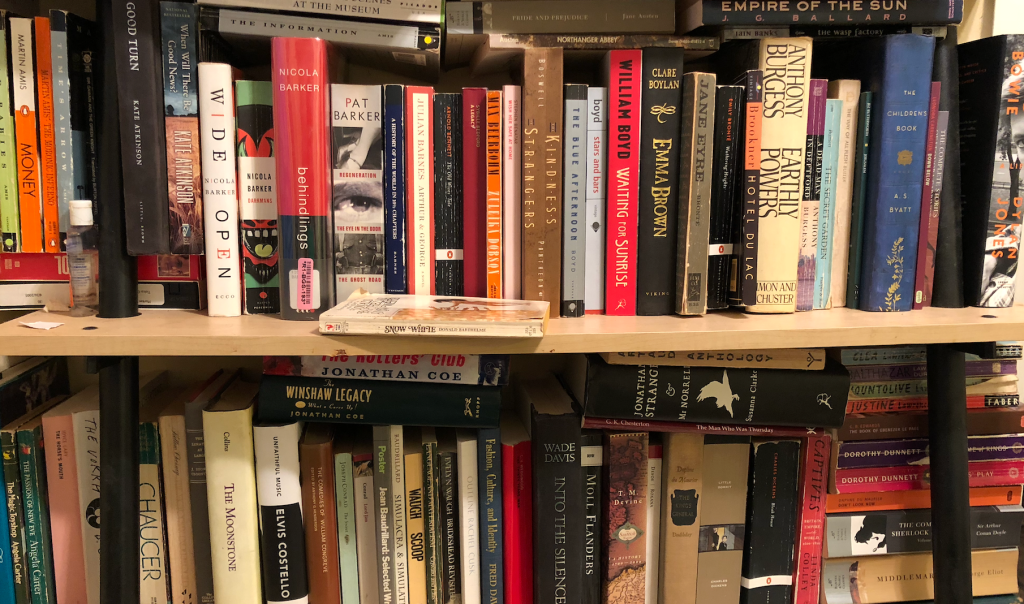
The other best thing you get off the beaten path are stories. And stories are kind of my thing. I write them. I tell them. I even write and tell them for work (though not always the flavor or style I gravitate toward off the clock). I also read them–lots of them—and live in what my mother suggests is an impending catastrophe of books. Shelves sag and groan. To-read stacks rise like cityscapes beside my bed.
I come from a family of readers, but also from a community of readers. Growing up Asheville, many of my most cherished memories wandering the stacks of local bookstores. I could tell you I grew up in Malaprops, whose stuffed shelves and patient staff willing to tolerate a kid both impossibly pretentious and painfully socially awkward had a lot to do with me surviving adolescence. I believed I could probably live anywhere so long as they had a bookstore and ideally a dive bar with a well-stocked jukebox. I meant it.
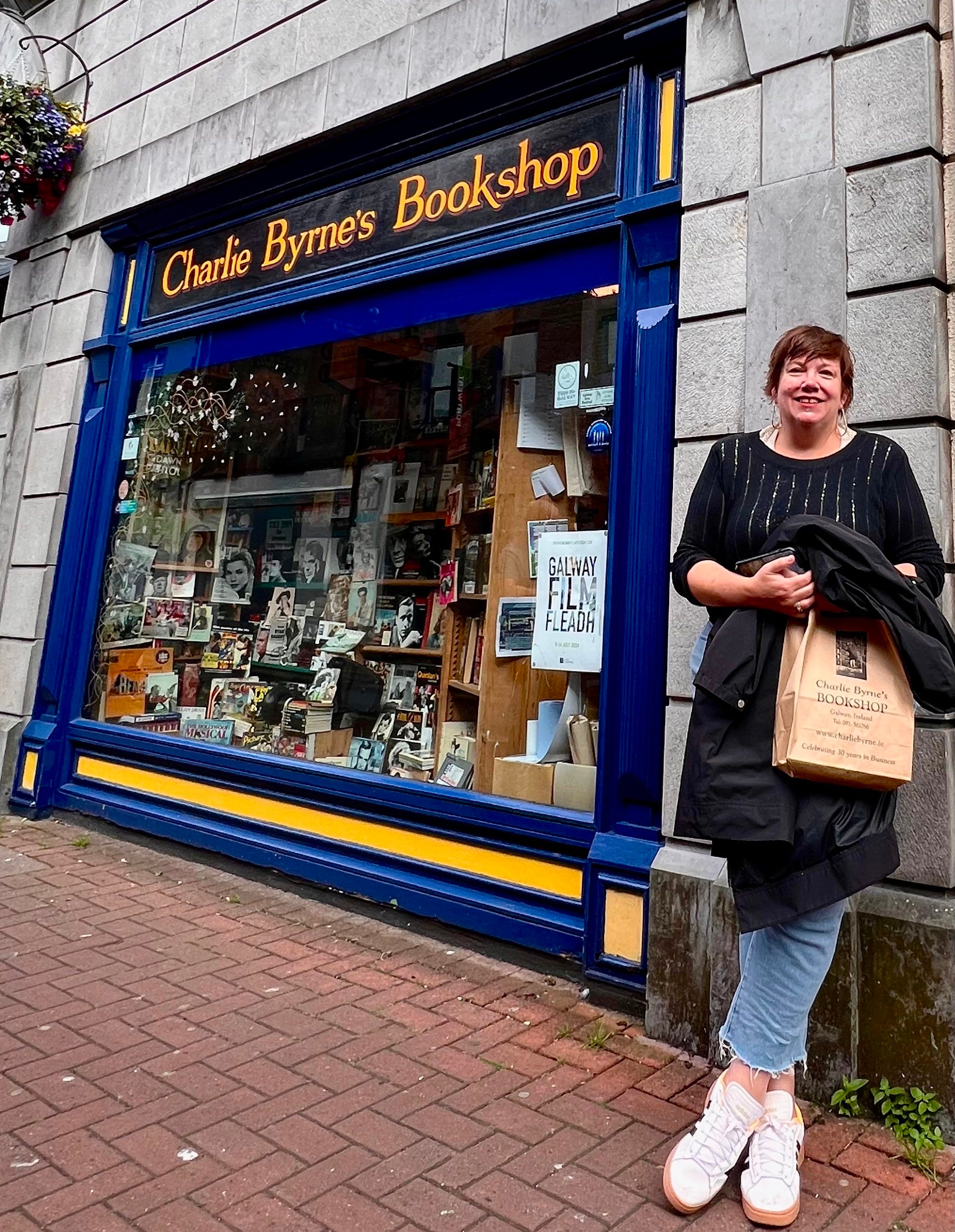
I visit bookstores whenever I travel. Sometimes so enthusiastically it requires an additional luggage purchase (credit to Charlie Byrne’s Bookshop in Galway, whose delightful staff half-jokingly offered to put me in touch with a guy that knew a guy with a container ship) You can get a great sense of place from a bookstore, sometimes even more so than a record store (and I worked at one for almost 15 years). It’s not just inventory or the staff or aesthetic. Book stores have vibes. I mean that more in the cringey GenX-using-GenZ-slang kind of way, as opposed to the “I grew up in Asheville and thus know my rising sign” kind of way (though I do—it’s Virgo). Some of that, I think, I think has to do with curation. No local, brick and mortar bookstore can carry everything. Not even Powells. The way books are ordered. The way favorite are displayed. The way the proprietor wants you to feel when you walk in the door. All bookstores contain hundreds of portals to other worlds. That’s the baseline enchantment built into the operation. Sometimes the real magic is seeing which ones they encourage you to take.
When I pulled off Interstate 40 in Morganton, on a sunny, springlike St. Paddy’s Day, bound for a week of office work in Asheville, I did not intend to embark on any new quests. I was just going to buy some gas. Maybe get another coffee to power me over the continental divide. I don’t know what it was that inspired me to search for local bookstores. The Fates? Idle Curiosity? Undiagnosed ADHD? But from the moment I entered Thornwell Books in downtown Morganton, I knew I’d found a new purpose. Visit all the bookstores. Not just the ones off the exit ramps on my typical peregrinations across the state. But all the local, independent bookstores dispersed among North Carolina’s 100 counties. From the Great Smoky Mountains to the Graveyard of the Atlantic. Just imagine what I might find.
I do not, as a rule, like rules. However, I had to set up some parameters lest I end up counting sheets strewn with paperbacks at every neighborhood yard sale. So, for our project purposes, the bookstore
1) Must be independent, no Barnes and Nobles, no Books-a-Millions, etc.
2) Must be curated, which is to say, it cannot be a warehouse. This is particularly relevant for used bookstores. I’m focusing on the ways where you can tell human being chose selection, book by book, as opposed to filing tables with an anonymous box of discards and remainders
3) Must be (broadly) secular. I’m not a practicing anything, so I’m not the right audience for an explicitly one-religion-only bookstore. I have zero issue with bookstores carrying explicitly religious content (I love a lot of explicitly religious titles, as anyone who has ever tried to talk to me about Graham Greene or Rumi will), but it must be balanced out with the rest.
4) Must be open to the public. If it’s an antiquarian “by appointment only” shop or an academic bookstore on a campus, sometimes the rules differ. I am not including ntrcampus bookstores unless there is significant compelling reason why I should. They are often not locally or independently owned. I would have made an exception for the old Bulls Head Bookshop at UNC, but it’s now a souvenir shop and Barnes and Noble, so, you know, alas Babylon.
Past that, the rules are only guidelines. While the primary focus of this project is hitting all the qualifying UNC bookshops (about 110, by my last count), I will occasionally hop over a state line or five if the travels take me.
This is not a review site. Anyone who runs a physical bookshop in our text-averse, reading-antagonistic, robot-written, screen-bound, education-afeared era is doing it because they love it and because they want to give something to the people of their community. Retail can be occasionally sublime, though often thankless work, especially when you’re selling something a good portion of the world believes to be at best irrelevant if not actively dangerous. I don’t have a wide knowledge of everything. I read a variety of genres, a little more fiction than non-fiction. I like to browse when I shop and get local recommendations. I have a Big List, which includes all the titles I’m interested I’m checking out but will not order because it’s more fun just running into them in the wild. Every bookstore I visit, I see if I can find anything on the Big List.
I’d love to interview booksellers as this progresses. It would be great to have their stories, their favorite book, and their favorite local details. And to that end, please feel free to reach out over at theshopplot@gmail.com or @theshopplot on Instagram. Tell me about your store.
I do work in tourism by day, and I love this state. I want people to stop and shop and ideally, take it slow going back to the car, just in case something else cool is around the bend. For now, I’m not making this into a video thing. I must assume, if you like bookstores, that you like to read, and maybe understand why not everything has to be filmed. I reserve the right to change my mind.
For now, new shops write-up every Friday, here.
Thanks for joining me in the stacks.
ALSO: if you’re looking for more content in These Troubled Times. Katie Kosma and I have relaunched Snap(shot) Fiction. She sends me a photo. I write a story. She edits. Things get weird. Come on over!
 Tiny Commotions